E-Textile Motion Suit
An easy-to-make e-textile platform.
I worked on this project during the first year of my Creative Technology master's degree, alongside two senior and PhD students, Marie Julou and Madalina Nicolae. Building the sensors taught me the basics of electronics.
The E-Textile Motion Suit is an easy-to-make e-textile platform. Fully integrated fabric sensors detect touch, position, and mesh deformation to capture the wearer's movements. Through playful applications, the project aims to make e-textile technology more accessible to non-professionals.
What are e-textiles?
Smart textiles, electronic textiles, or e-textiles are fabrics infused with electronic components and functionality[1]. Their main applications are:
- Health and wellness: monitoring vital signs, tracking physical activity, and detecting changes in the body;
- Sports and fitness: tracking athletes' performance and giving feedback on technique;
- Fashion: interactive, responsive clothing for new forms of self-expression and personalization[2].
Three generations of e-textiles have gradually emerged:
- Passive e-textiles: simple conductive fabrics enabling basic functions such as sensors and switches.
- Active e-textiles: fabrics with components like LEDs, batteries, and microcontrollers, used to make garments that light up, change color, or react to their environment.
- Functional e-textiles: still in development, capable of advanced functions such as biometric monitoring, energy harvesting, and data communication[3].
Despite this progress, e-textiles remain hard to reach for non-experts. Cost, comfort, durability, and the lack of learning platforms are still real barriers. Today the most accessible form of non-commercial e-textile lives in the cosplay and DIY community. Through collaboration, education, and standardization, e-textiles could become far more practical for students and beginners.
Project presentation
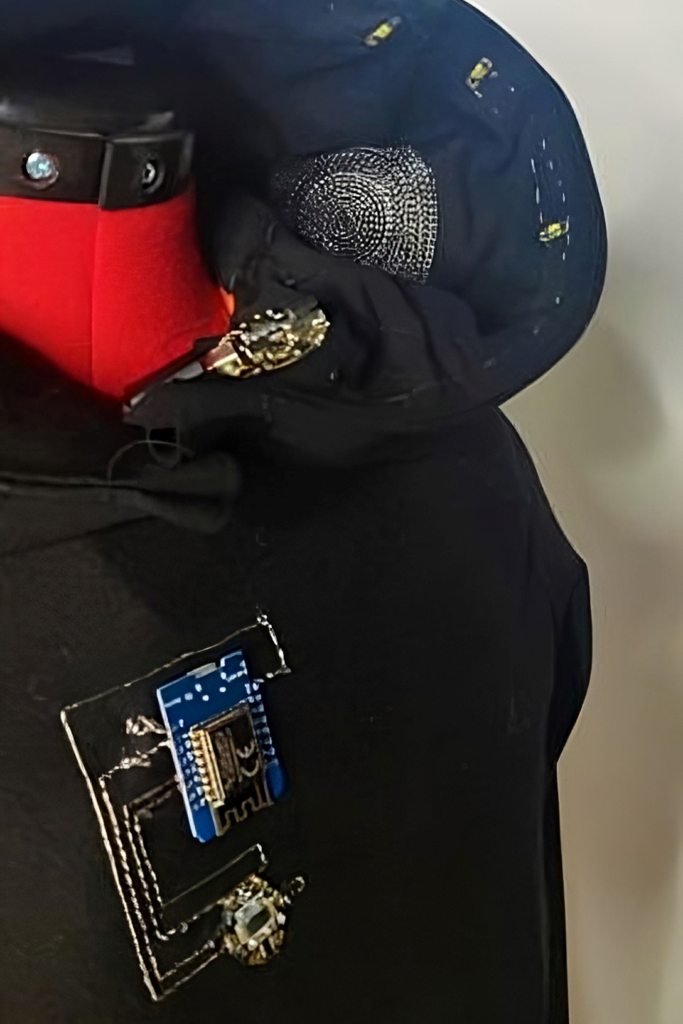
The project focuses on making the first and second generations of e-textiles accessible to the general public through fast-prototyping practices. Building the sensors and displays only requires basic sewing and electronics skills, both approachable for beginners.
The electronic parts are off-the-shelf components from Adafruit, commonly used in cosplay; the boards are popular in DIY projects; and the sewing materials are available in specialized shops. The suit gives a hands-on understanding of how to integrate electronics into fabric, and offers playful, artistic applications of e-textile — such as a garment that produces music from the wearer's movements.
Project details
Architecture
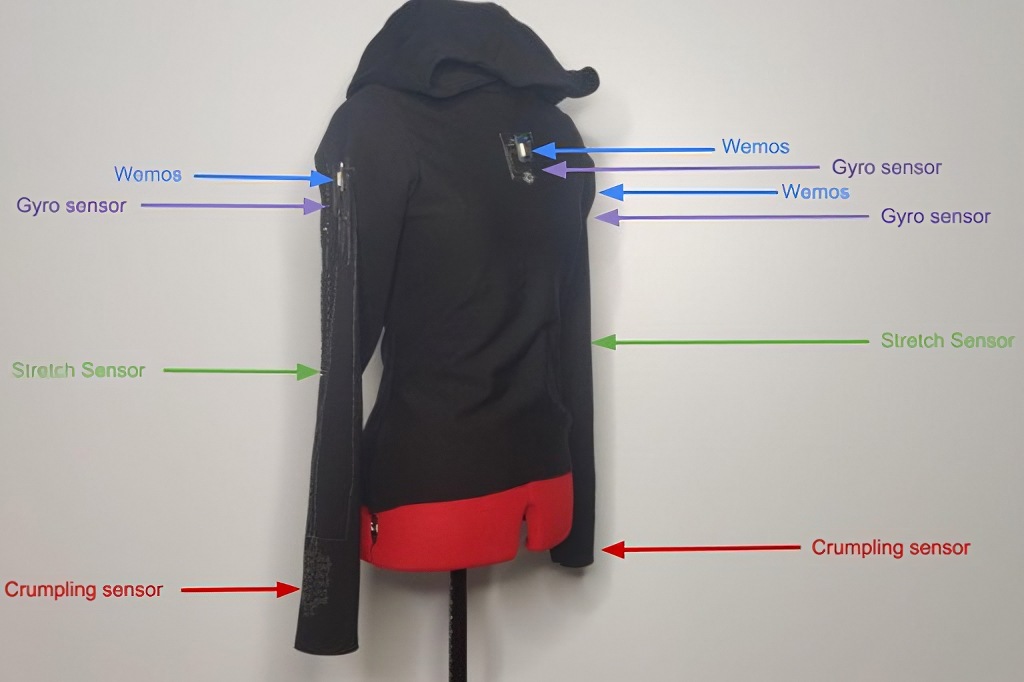
Mechanical movement sensors capture the wearer's motion. Three ESP8266 Wemos Lolin D1 mini microcontrollers (left, middle, and right) send this data to a server, which triggers audio-visual feedback whenever new information arrives.
- Two stretch sensors on the right and left elbows sense the fabric stretching as the elbow bends.
- Inertial sensors on the lower deltoids and the middle of the rib cage measure the orientation of the arms and torso.
- Crumple sensors at the ends of both sleeves measure the wearer's grip.
1. Stretch sensors
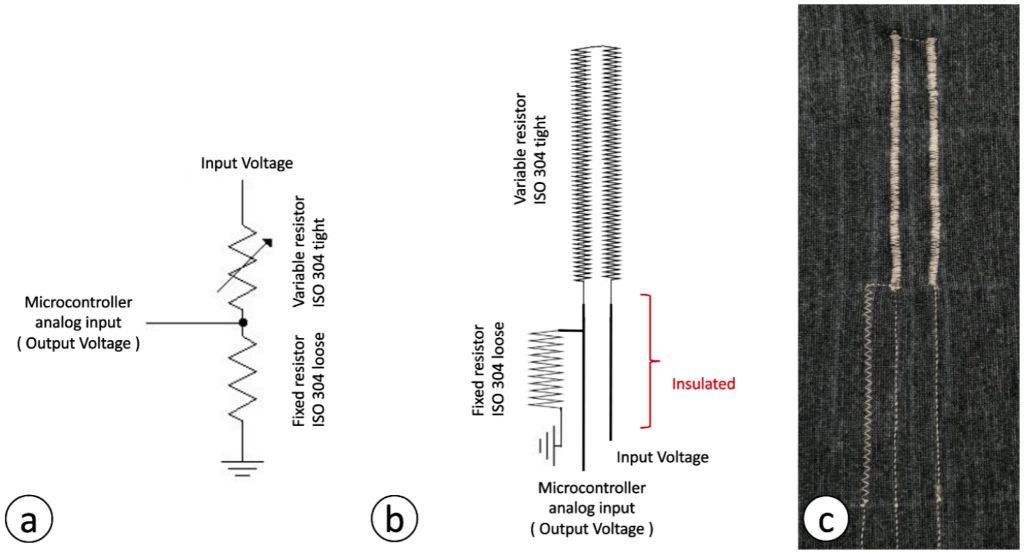
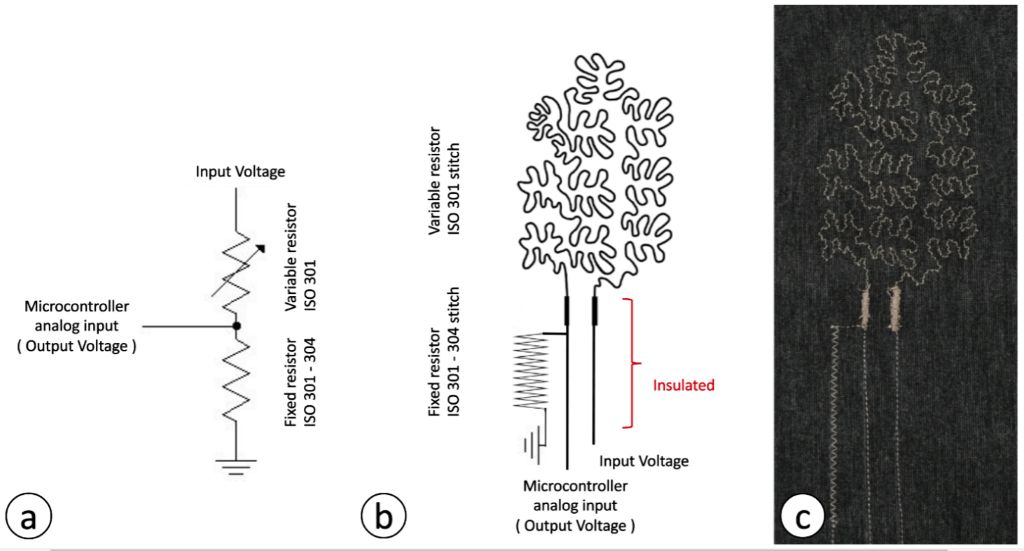
Stretch and crease sensors work alike: both have a resistance that varies with the number of contact points. The sensor is made with a tight zigzag stitch using conductive thread in the bottom spool. Stretching the fabric raises the resistance along the conductive thread[4]: the opening mesh breaks the parallel contact points, so the current flows in series rather than in parallel.
2. Crumple sensors
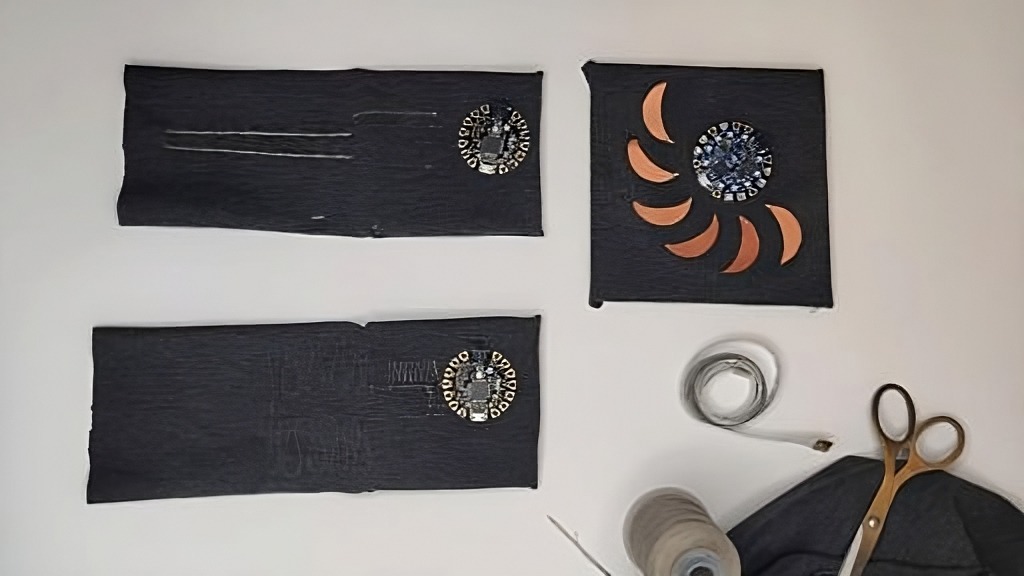
Here the conductive thread is sewn across an entire surface. When the fabric wrinkles, it folds onto itself and creates contact points that let the current short-circuit the pattern, so the resistance drops accordingly.
3. LED interfaces
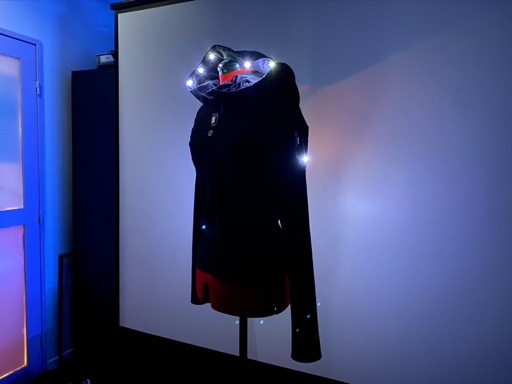
The LEDs are off-the-shelf sewable sequins from Adafruit[5], hand-sewn directly onto the sleeves and hood using the same process as the gyroscopic sensors. For now they are purely aesthetic, but they can easily be driven by the integrated GEMMA microcontrollers[6].
4. Gyroscopic sensors
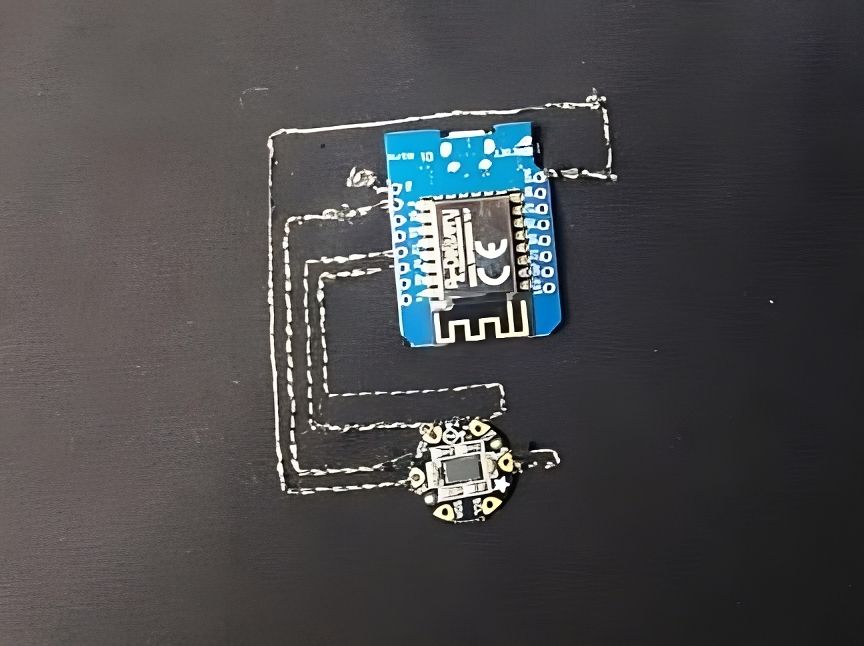
An accelerometer measures linear, non-gravitational acceleration. Three off-the-shelf accelerometers from Adafruit record acceleration and speed in the shoulder and torso area[7]. The connector is hand-sketched, imported into DRAWings as a PNG, then vectorized, rescaled, and turned into an ISO 301 stitch. The sensor is finally embroidered upside-down with that stitch on the outer surface of the sleeve.
References
- Končar V. Smart textiles and their applications — visual perceptions. Proceedings of 9th International Symposium on Graphic Engineering and Design. Nov. 2018. doi: 10.24867/grid-2018-p1
- Cherenack K, van Pieterson L. Smart textiles: Challenges and opportunities. Journal of Applied Physics. 2012, doi: 10.1063/1.4742728
- Ruckdashel RR, Khadse N, Park JH. Smart E-Textiles: Overview of Components and Outlook. Sensors. 2022, doi: 10.3390/s22166055
- Tangsirinaruenart O, Stylios G. A Novel Textile Stitch-Based Strain Sensor for Wearable End Users. Materials. 2019, doi: 10.3390/ma12091469
- Adafruit. LED Sequins — Warm White. adafruit.com/product/1758
- Adafruit. GEMMA v2 — Miniature wearable electronic platform. adafruit.com/product/1222
- Adafruit. FLORA Accelerometer/Compass Sensor — LSM303. adafruit.com/product/1247